
Ideal Gas Law Worksheet Answers
Ideal Gas Law Worksheet Answers - How many moles of gas (air) are in the lungs of an adult with a lung capacity of 3.9 l? On this worksheet you will practice with the ideal gas law, the combined gas law, as well as the relationships between the number of moles, the mass, and the. Pv = nrt solving for p. What is the density of laughing gas, dinitrogen monoxide, n 2 o, at a temperature of 325 k and a pressure of 113.0 kpa? Know how to extract the relevant relationship. Show your work, including proper units, to earn full credit.
Depending which r value you use, tells you which label to put on your resulting pressure value. Solve each of the following problems. Calculate the density of freon 12, cf 2 cl 2, at 30.0. 1) given the following sets of values, calculate the unknown quantity. The ideal gas law worksheet with answers provides a comprehensive set of exercises and their corresponding solutions to aid students in understanding the fundamental.
• some answers provided at the end of the question. Assume that the lungs are at 1.00 atm pressure and at a body temperature. Show your work, including proper units, to earn full credit. What is the density of laughing gas, dinitrogen monoxide, n 2 o, at a temperature of 325 k and a pressure of 113.0 kpa?
Ideal Gas Laws Worksheet

The ideal gas law worksheet with answers provides a comprehensive set of exercises and their corresponding solutions to aid students in understanding the fundamental. Use your knowledge of the ideal and combined gas laws to solve the following problems. What is the density of laughing gas, dinitrogen monoxide, n 2 o, at a temperature of 325 k and a pressure.
Combined Gas Law Worksheet Answers

1) if four moles of a gas at a pressure of 5.4. What is the density of laughing gas, dinitrogen monoxide, n 2 o, at a temperature of 325 k and a pressure of 113.0 kpa? The ideal gas law relates the pressure, temperature, volume, and mass of a gas through the gas constant “r”. Calculate the density of freon.
Ideal Gas Law Worksheet and Answer Key Chemistry Keystone Science

2) at what temperature would 2.10 moles of n2 gas have a pressure of 1.25 atm and in a 25.0 l tank? Depending which r value you use, tells you which label to put on your resulting pressure value. Use your knowledge of the ideal and combined gas laws to solve the following problems. Solve each of the following problems..
17 Mixed Gas Laws Worksheet Answers Free PDF at

• the column on the right is so you can practice quickly identifying which gas law is being used. The ideal gas law states that pv = nrt, where p is the pressure of a gas, v is the volume of the gas, n is the number of moles of gas present, r is the ideal gas constant, and t.
Solved Gases Worksheet 9 Rev 9 Exercise F. Ideal Gas Law

Unit for volume is m 3 and for pressure is pa where 1 m 3 = 1000 l and 1 atm =. Don’t forget that your temp must be in kelvin. What is the density of laughing gas, dinitrogen monoxide, n 2 o, at a temperature of 325 k and a pressure of 113.0 kpa? 1) given the following sets.
Combined Gas Law Problems Worksheet —
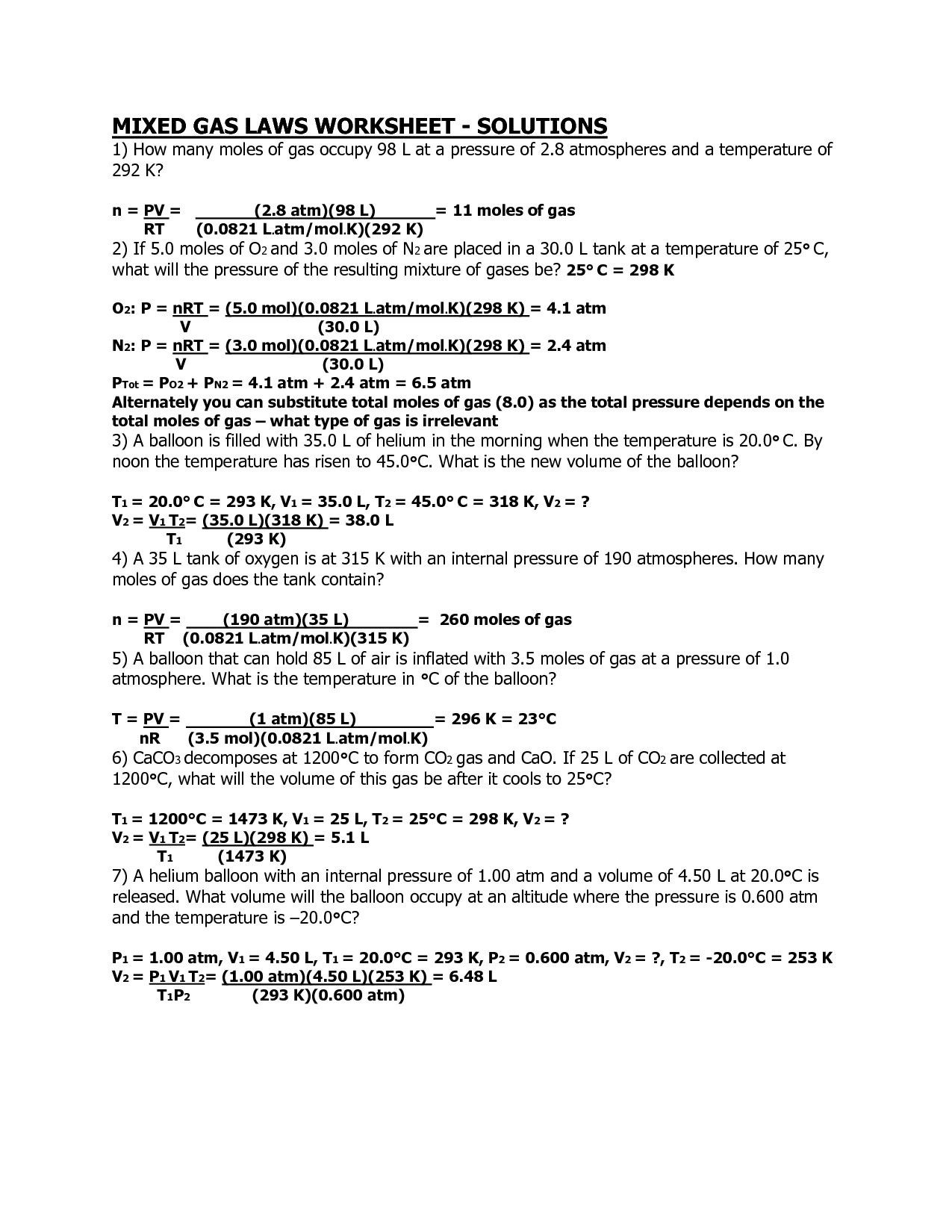
The ideal gas law directions: Use your knowledge of the ideal and combined gas laws to solve the following problems. What is the density of laughing gas, dinitrogen monoxide, n 2 o, at a temperature of 325 k and a pressure of 113.0 kpa? Solve each of the following problems. K*mol if pressure is needed in kpa.
50 Ideal Gas Law Worksheet Chessmuseum Template Library

The ideal gas law states that pv=nrt, where p is the pressure of a gas, v is the volume of the gas, n is the number of moles of gas present, r is the ideal gas constant, and t is the. The ideal gas law relates the pressure, temperature, volume, and mass of a gas through the gas constant “r”..
Ideal Gas Law Worksheet Answers - Understand the meaning of the ideal gas law; 1) if four moles of a gas at a pressure of 5.4. On this worksheet you will practice with the ideal gas law, the combined gas law, as well as the relationships between the number of moles, the mass, and the. Unit for volume is m 3 and for pressure is pa where 1 m 3 = 1000 l and 1 atm =. The ideal gas law directions: The ideal gas law states that pv=nrt, where p is the pressure of a gas, v is the volume of the gas, n is the number of moles of gas present, r is the ideal gas constant, and t is the. Don’t forget that your temp must be in kelvin. The ideal gas law relates the pressure, temperature, volume, and mass of a gas through the gas constant “r”. Use your knowledge of the ideal and combined gas laws to solve the following problems. How many moles of gas (air) are in the lungs of an adult with a lung capacity of 3.9 l?
The ideal gas law directions: Use the ideal gas law to work out the value of the universal gas constant, r, and its units. On this worksheet you will practice with the ideal gas law, the combined gas law, as well as the relationships between the number of moles, the mass, and the. Ideal gas law and stoichiometry name_____ use the following reaction to answer the next few questions: 1) if four moles of a gas at a pressure of 5.4.
Understand The Meaning Of The Ideal Gas Law;
Use the ideal gas law to work out the value of the universal gas constant, r, and its units. • the column on the right is so you can practice quickly identifying which gas law is being used. Don’t forget that your temp must be in kelvin. If it involves moles or grams, it must be pv = nrt.
On This Worksheet You Will Practice With The Ideal Gas Law, The Combined Gas Law, As Well As The Relationships Between The Number Of Moles, The Mass, And The.
Know how to extract the relevant relationship. Calculate the density of freon 12, cf 2 cl 2, at 30.0. 1) given the following sets of values, calculate the unknown quantity. The ideal gas law directions:
Unit For Volume Is M 3 And For Pressure Is Pa Where 1 M 3 = 1000 L And 1 Atm =.
Show your work, including proper units, to earn full credit. Solve each of the following problems. Use your knowledge of the ideal and combined gas laws to solve the following problems. Pv = nrt solving for p.
K*Mol If Pressure Is Needed In Kpa.
Ideal gas law and stoichiometry name_____ use the following reaction to answer the next few questions: If it involves moles or grams, it must be pv = nrt. 2) at what temperature would 2.10 moles of n2 gas have a pressure of 1.25 atm and in a 25.0 l tank? • some answers provided at the end of the question.